Copyright and registered design law are an integral part of the armoury of rights available to creators of intellectual property (IP).
Whilst copyright protection is afforded to works automatically, registered design rights are only afforded to designs formally registered with IP Australia. The Copyright Act 1968 (Cth) and Designs Act 2003 (Cth) preclude these rights from existing simultaneously, however they share a common purpose: To stop others producing counterfeit or substantially similar products.
These rights are critical to protecting a business’s competitive advantage, including against copycats in the market.
From early-stage concepts and sketches through to prototypes and manufactured products, different forms of IP protection arise at different stages of the design creation process.
The table below outlines whether each stage of the product design lifecycle is protectable under either design law or copyright law. This article uses furniture products as an illustrative example, however the same principles apply to other products, such fashion and household items.
| Step in Design Process | Example | Protected under Copyright Law? | Capable of Protection under Design Law? |
|---|---|---|---|
| 1. Concept Stage: Initial concept sketches are drawn and/or rendered by company’s design team. |  |
1. Before industrial application:[1] Yes. Sketches are protected under copyright law as an ‘artistic work’.
2. After industrial application: Likely. It is likely that the sketches would still be protected. A challenge to copyright protection would arise if the products are considered a ‘corresponding design’[2] to the sketches. If the design has not been finalised at this stage, we assume that the visual features are not embodied in a way that would result in a reproduction of that work. |
Unlikely. However possible if the visual features of the product in the sketch are embodied in the final product.[3]
Takeout point: Likely automatically protected under copyright law, but unlikely to be protectable under design law. |
| 2. Design Phase: The final design is created using software such as InDesign, SketchUp and rendering programmes. |  |
1. Before industrial application: Yes. Renders are protected under copyright law as an ‘artistic work’. 2. After industrial application: Unlikely. Copyright protection is lost if the renders are sufficiently close to the product so as to render it a ‘corresponding design’.[4] 3. After design registration: Unlikely. Copyright protection is lost if the renders are sufficiently close to the product so as to render it a ‘corresponding design’.[5] |
Likely. The 2D drawing does not need to have details such as specific measurements. The High Court has stated that there must be sufficient “individuality of appearance” to distinguish the design from “the fundamental form”, and that “the existence of that sort of individuality is to be determined by the eye and not by measuring dimensions”.[6]
What is necessary is that the proportions of the various elements of the design and their relationships to each other are sufficiently definite to be apparent to the visual inspection of the eye. Takeout point: Likely automatically protected under copyright law unless industrially applied; likely protectable under design law. |
| 3. Factory Phase: The factory team makes drawings of the design, typically using AutoCad, in order to translate the designs into what is technically achievable. At this stage, the factory team is concerned with the technical engineering aspect (function) of the product, as opposed to the design. | 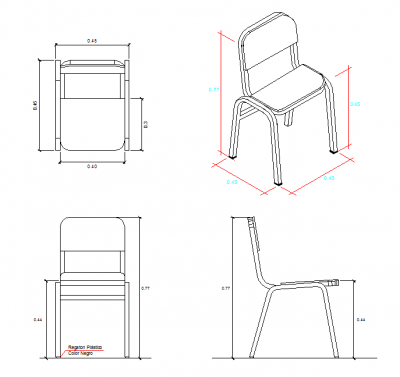 |
1. Before industrial application: Likely. Drawings are protected under copyright law as an ‘artistic work’.
2. After industrial application: Unlikely. Copyright protection is likely lost, as it is more certain that the drawings are sufficiently close to the product so as to render the product a ‘corresponding design’. 3. After design registration: Unlikely. Copyright protection is likely lost, as it is more certain that the drawings are sufficiently close to the product so as to render the product a ‘corresponding design’. |
Likely. This is the kind of visual representation that is typically provided to IP Australia as part of the registered design process (with measurements removed).
Takeout point: Likely automatically protected under copyright law unless industrially applied; likely protectable under design law. |
| 4. Production/Technical Drawing Phase: The factory produces ‘shop’ drawings, which breaks down AutoCad drawings into components and mass production processes. | 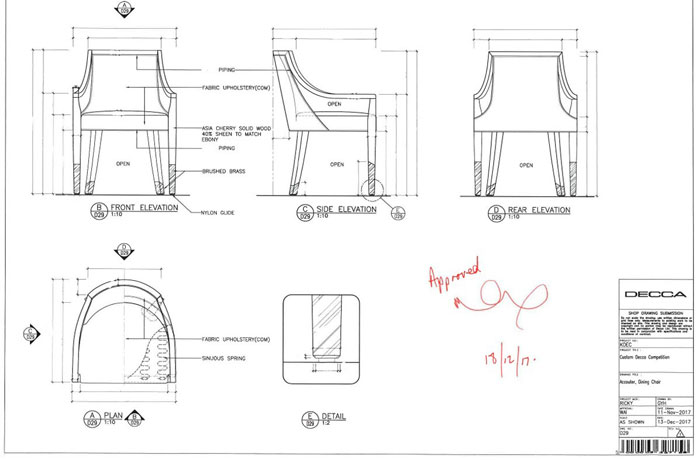 |
1. Before industrial application: Likely. The drawing is protected under Copyright Law as an ‘artistic work’.
2. After industrial application: Unlikely. While copyright protection is likely lost, this ultimately depends on whether it is sufficiently close to the product so as to render the product a ‘corresponding design’. 3. After design registration: Unlikely. While copyright protection is likely lost, this ultimately depends on whether it is sufficiently close to the product so as to render the product a ‘corresponding design’. |
Possibly, depending on the drawing. A registered design must relate to a specific shape or pattern applied to an article, and the courts will not uphold as valid an attempt to protect a mode of construction by registration of a design. For example, in Warman International v Envirotech Australia Pty Ltd,[7] it was held that drawings containing data and tolerances constituted a method or principle of construction, making it not capable of registration under the Designs Act.
In contrast, where a drawing both embodies the design and contains technological data necessary for the article’s construction, that does not prevent the drawing from being registered as a design.[8] Takeout point: Likely automatically protected under copyright law unless industrially applied; likely registrable as design unless it is merely a method or principle of construction. |
| 5. Prototype Manufacturing Phase: Prototype products are manufactured based on the designs. |  |
No. A 3-dimensional product is not protectable under copyright law.
However, as the design has not been industrially applied at this stage, copyright subsists in the 2-dimensional drawings, as set out above. |
Yes. The design embodied in the product is capable of protection as a registered design.
Takeout point: Not protected under copyright law; protectable under design law. |
| 6. Manufacturing Phase: Prototype products are manufactured on a larger scale based on the designs. |  |
No. A 3-dimensional product is not protected under copyright law.
Any copyright that subsisted in the 2-dimensional drawings of the product is lost. |
Yes. The design embodied in the product is capable of protection as a registered design. However, the application must be made before the product is released to the public to satisfy the ‘new and distinctive’ requirement.[9]
Takeout point: Not protected under copyright law; protectable under design law if application made before public release. |
Does your business design and commercialise products? For advice on protecting the IP in your designs, please contact us below. Edwards + Co Legal provides intellectual property advice to modern Australian businesses.
[1] ‘Industrial Application’ means that a design is applied to more than 50 articles (Copyright Regulations 2017, reg 12).
[2] A ‘corresponding design in relation to an artistic work means the visual features of shape or configuration which, when embodied in a product, result in a reproduction of that work, whether or not the visual features constitute a design that is capable of being registered [as a design]’ (Copyright Act, s 74).
[3] A ‘design’ is the ‘overall appearance of the product resulting from one or more visual features of the product’ (Designs Act, s 5).
[4] Copyright Act 1968 (Cth), s 77.
[5] Copyright Act 1968 (Cth), s 75.
[6] Malleys Ltd v J W Tomlin Pty Ltd 35 ALJR 352.
[7] (1986) 6 IPR 578.
[8] Compagnie Industrielle De Precontrainte et D’Equipment Des Constructions SA v First Melbourne Securities Pty Ltd [1999] FCA 660.
[9] Designs Act 2003 (Cth), s 43.

